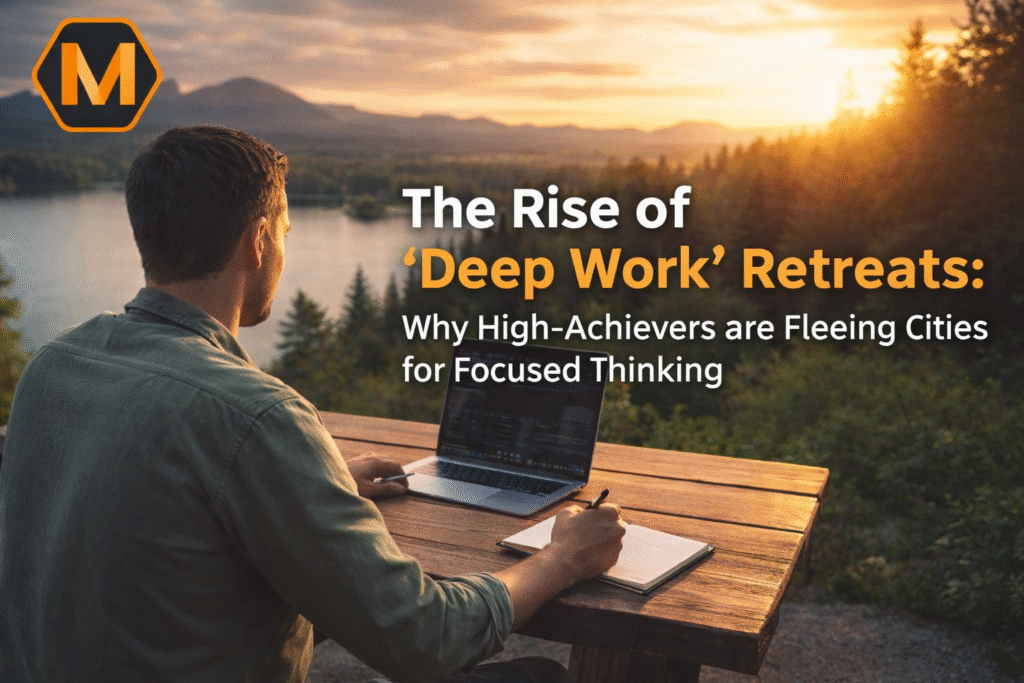
The shift in how we work and study in 2026 isn’t just about moving from the office to the home; it’s about moving from the noise to the silence. As digital fatigue reaches an all-time high, a new trend has emerged among the UK’s elite professionals and top-tier students: the “Deep Work” retreat. These are not just vacations; they are radical attempts to reclaim the human brain from the constant ping of notifications and the shallow “vibe coding” culture of the city. High-achievers are increasingly fleeing London, Manchester, and Birmingham for the quiet of the Cotswolds or the Scottish Highlands, seeking an environment where they can think without interruption.
The primary driver behind this exodus is a concept known as “attention residue.” Every time you check a WhatsApp message or a news alert, a part of your brain stays stuck on that interruption for up to twenty minutes. In a bustling city environment, your brain never truly belongs to you. This is why many students find it impossible to complete complex projects on their own. When the pressure of a looming deadline becomes too much, some look for Assignment Help from established platforms like myassignmenthelp to bridge the gap while they recalibrate their focus. By outsourcing the busywork, they can dedicate their limited “deep work” hours to the most critical parts of their research, ensuring that their cognitive energy isn’t wasted on administrative exhaustion.
The Science of the “Appstinence” Movement
In 2026, the “Appstinence” movement has gone mainstream. People are realizing that our brains were not designed to process thousands of data points every hour. Deep Work, a term popularized by Cal Newport but evolved for the modern AI era, refers to professional activities performed in a state of distraction-free concentration that push your cognitive capabilities to their limit. These efforts create new value, improve your skill, and are hard to replicate.
The rise of retreats specifically designed for this purpose—offering “analog-only” rooms and Faraday cages for smartphones—proves that focus has become the most valuable currency of the new economy. If you can’t focus for four hours straight, you simply cannot compete in a world where AI handles all the shallow tasks. High-achievers realize that if they don’t protect their focus, they lose their competitive edge.
The Impact of Environment on Mental Clarity
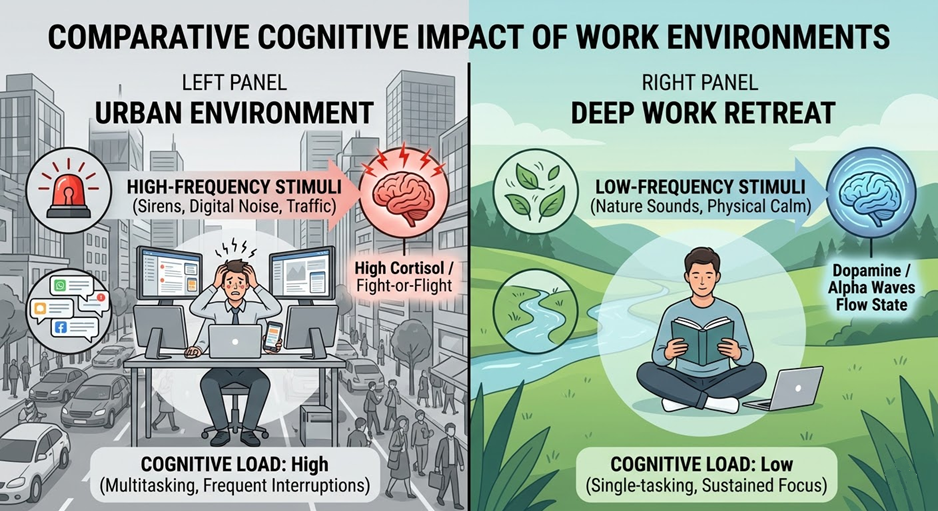
A 2026 report by the Global Wellness Summit highlights that “Nervous System Exhaustion” is now a primary motivator for travel. High-achievers are no longer looking for luxury spas; they are looking for “Cognitive Wellness” centers. These environments utilize Attention Restoration Theory (ART), which suggests that natural settings help the brain recover from “directed attention fatigue”—the mental tiredness caused by constant urban stimulation.
| Feature | Urban Work Environment | Deep Work Retreat (Rural) |
| Primary Stimuli | High-frequency (Sirens, Notifications) | Low-frequency (Wind, Water, Birds) |
| Attention Type | Forced/Directed | Soft Fascination (Effortless) |
| Cognitive Load | High (Multitasking encouraged) | Low (Single-tasking prioritized) |
| Mental State | Fight-or-Flight (High Cortisol) | Flow State (High Dopamine/Alpha Waves) |
Breaking the Cycle of Academic Burnout
For students, the stakes are even higher. The 2026 UK curriculum review has placed a massive emphasis on “Information Gain”—the ability to provide new, unique insights rather than just repeating facts. This requires a level of thought that a noisy dorm room or a crowded coffee shop cannot provide. Academic burnout is no longer just “stress”; it is a clinical state of cognitive depletion.
Recent 2026 statistics from Mental Health UK reveal that 91% of adults have experienced high or extreme pressure in the past year, with young workers aged 18–24 being the most likely to take time off for mental health. This demographic is increasingly turning to structured retreats to finish high-stakes projects. When a student is faced with a 50-page dissertation or a complex data analysis project, the sheer volume of work can paralyze the mind. This is where professional support becomes a strategic tool rather than a shortcut. For instance, seeking statistics assignment help is a common way for students to handle the heavy lifting of data modeling so they can focus on the higher-level analysis and conclusion of their thesis.
Why Cities are Becoming “Cognitive Deserts”
It might seem ironic to call a city like London a “cognitive desert,” but from the perspective of deep thinking, that is exactly what they have become. The sensory orgy of a modern city—the constant transit noise, the high-density Wi-Fi signals, and the rapid-fire social expectations—creates a state of “continuous partial attention.”
High-achievers are fleeing to rural retreats because nature provides “soft fascination.” Looking at a forest or a lake doesn’t demand your attention in the way a flashing neon sign does. It allows your prefrontal cortex to rest. This rest period is essential for neuroplasticity. When you are in a deep work retreat, your brain actually begins to rewire itself to handle more complex information. This is the “secret sauce” of the world’s most successful researchers and CEOs.
Deep Work Workflow: From Chaos to Clarity
Below is the standard workflow adopted by 2026 “Deep Work” practitioners to ensure maximum output during their retreats:
- The Shutdown Ritual: Closing all 20+ browser tabs and logging out of communication tools.
- Environment Priming: Lighting a specific scent or starting a “focus” audio track to trigger the brain.
- The 90-Minute Sprint: Working on a single, high-stakes task with zero interruptions.
- The Soft Fascination Break: A 20-minute walk in nature (no phone) to allow the “default mode network” to process the work.
- Synthesis & Review: Summarizing the insights gained to ensure “Information Gain” for the final project.
See also: Affordable Possum Removal Central Coast: Prices, Methods & Tips
Creating Your Own “Deep Work” Environment
You don’t necessarily need to rent a cabin in the woods to benefit from these principles. You can create a “synthetic retreat” at home by following a few strict rules:
- The Analog Morning: No digital devices for the first three hours of the day.
- The Single-Tasking Mandate: Research shows that 79% of workers in 2026 can’t go one hour without a distraction. You must break this by using site blockers and “Focus Mode” on all hardware.
- Ergonomic Investment: A sit-stand desk and proper lighting aren’t luxuries; they are tools that prevent the physical fatigue that often mimics mental burnout.
The goal is to signal to your brain that it is time to go deep. In 2026, those who can master their environment will always outperform those who are slaves to their devices.
The Economic Value of Focused Thinking
In the 2026 job market, “synthesis” is the most sought-after skill. Since AI can now generate basic reports and code, the human’s job is to connect disparate ideas—to see the link between a global shipping crisis in the Strait of Hormuz and the price of local consumer goods. This kind of “connecting the dots” can only happen in a state of deep focus.
For those in academia, the transition from “learning” to “original research” is the hardest jump to make. A 2025 study on master’s students found that cognitive dissonance—the gap between what you know and what you need to produce—is the #1 cause of procrastination. By utilizing a “Deep Work” retreat framework, students can close this gap.
The “Wildcard” Productivity Strategy: Variety in Focus
While the rural retreat is the gold standard, some high-achievers are experimenting with “Social Wellness” retreats. These involve silent co-working spaces where the presence of others creates a “body doubling” effect, keeping everyone accountable without the need for verbal interaction. This proves that while we need silence, we also thrive on shared intention.
Final Thoughts: The Future is Deep
As we move further into the decade, the gap between the “focused” and the “distracted” will widen into a canyon. High-achievers aren’t fleeing cities because they hate the urban lifestyle; they are fleeing because they value their minds. They realize that in an age of infinite distraction, the ability to stay focused on one thing for a long time is a superpower.
Whether you are using professional services to manage your workload or heading to the mountains to write your next book, the objective is the same: protect your cognitive capital. The rise of deep work retreats is a sign that we are finally starting to treat our attention with the respect it deserves.
Frequently Asked Questions
What exactly is a “Deep Work” retreat?
It is a dedicated period of time spent in a distraction-free environment, usually away from urban centers, designed to facilitate intense concentration. Unlike a standard holiday, the goal is to reach a “flow state” to complete cognitively demanding tasks that require several hours of uninterrupted focus.
How does nature help with mental productivity?
According to Attention Restoration Theory, natural landscapes provide “soft fascination,” which allows the brain’s deliberate focus mechanisms to rest. This reduces mental fatigue and replenishes the cognitive resources needed for complex problem-solving and creative synthesis.
Can I replicate these benefits without traveling?
Yes. You can create a “micro-retreat” by implementing strict digital boundaries, such as using airplane mode for set blocks of time, clearing your physical workspace of visual clutter, and using specific sensory cues—like a particular playlist—to signal to your brain that it is time for deep concentration.
What is “attention residue” and why is it harmful?
Attention residue occurs when you quickly switch from one task to another; a part of your mind stays focused on the previous activity. This fragmented state prevents you from reaching the depth of thought required for high-level research, making your work take longer and increasing the likelihood of errors.
About The Author
Ella Thompson is a dedicated education consultant and digital strategist for MyAssignmentHelp. With a focus on modernizing academic workflows, Ella specializes in helping students and professionals navigate the complexities of 21st-century research. By bridging the gap between cognitive wellness and technical execution, Ella provides actionable insights for those seeking to enhance their productivity and achieve sustainable academic success.